Best Bike radar: Budget options 2026, top picks and comparison
Prices in USD are indicative: they are converted from the reference catalogue prices in euros at a fixed rate (EUR 1 = $1.08, 9 Sep 2026) and are not prices from a local retailer. The price at your retailer prevails. (14 Sep 2026)
How alerts reach your device sets apart models of budget bike radar. The filters help you narrow down your choice to suit your needs.
Prices collected from retailers are for guidance only: they may have changed since, the current price is the one shown by the retailer. No price is shown for models sold only on Amazon. Amounts converted from reference prices in euros using a dated exchange rate.
How we picked these models
- 2 models selected because they have the feature “$0 – $80” according to data published by manufacturers and retailers.
- See how we rate →
- No brand pays to be included in this selection or to rank higher.
Why get a budget bike radar?
Why add radar to your rear light
The best budget bike radar is, first and foremost, one that sends alerts to a compatible device you already own. The selection on this page covers budget models. But the features described differ: to make a useful choice, you need to distinguish between vehicle detection, the light’s response and the information you actually receive at the handlebars.
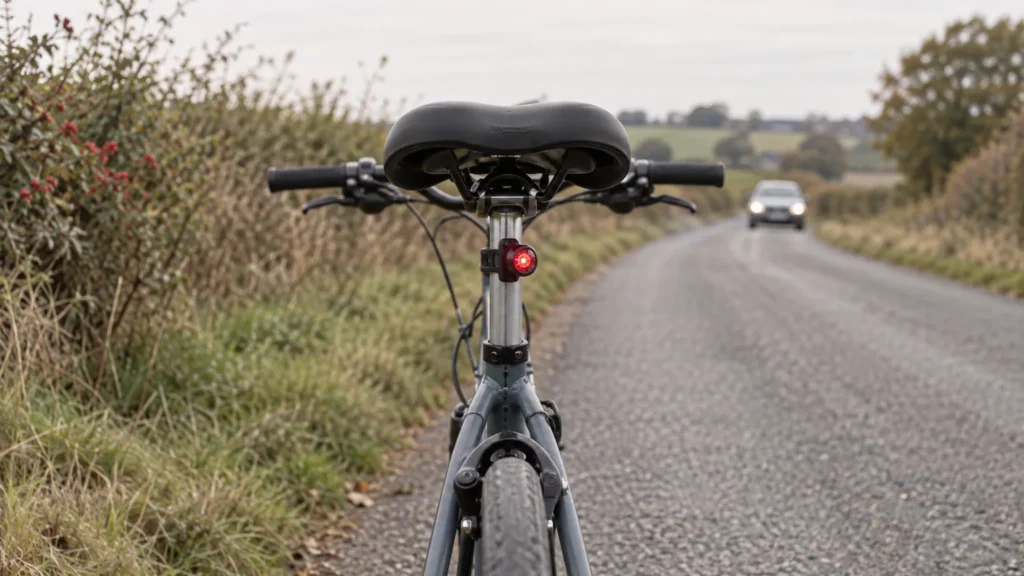
A rear bike radar detects vehicles approaching from behind. When it can send information to your bike computer or phone, it helps you become aware of traffic before you hear it. This is useful on roads shared with cars, whether you are out for a training ride or commuting.
This addition may be particularly useful for:
- Cyclists who regularly ride on roads open to traffic.
- People who cycle to work and want to stay more aware of vehicles approaching from behind.
- Riders who already own a compatible bike computer and want to add to their equipment.
However, keep this essential habit in mind: an alert never replaces a visual check before turning or moving out. The absence of an alert does not guarantee that the road is clear. Radar provides additional information without making decisions for you.
Being visible and receiving alerts meet different needs
A light that responds to an approaching car aims to attract the driver's attention. An alert displayed on your bike computer tells you about that approaching vehicle. These functions can coexist, but a responsive light does not prove that an alert is sent to the cyclist.
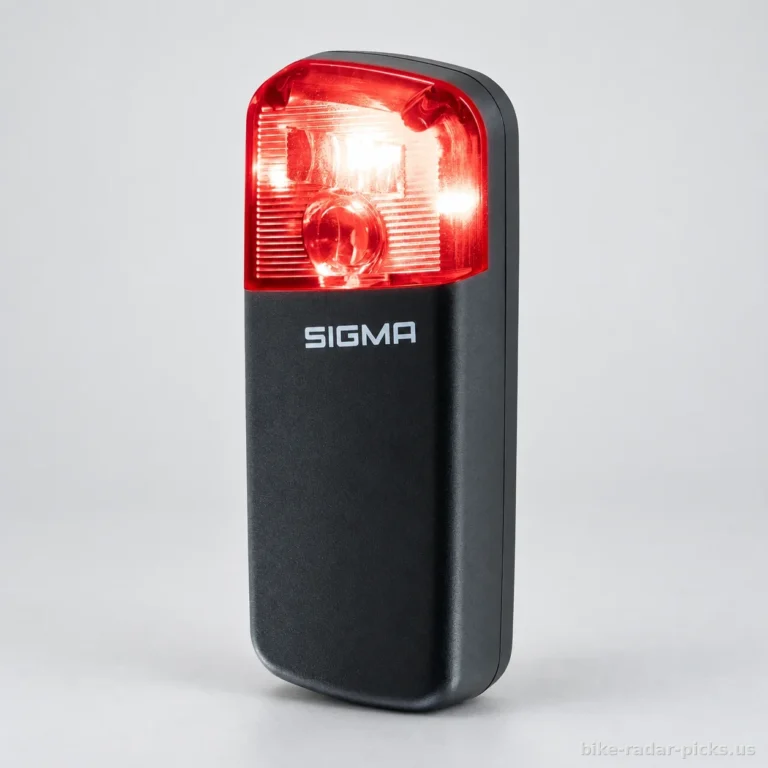
The Magicshine SEEMEE 100AD illustrates this distinction. Its specifications describe automatic detection that triggers a powerful flashing light. However, they do not mention any transmission to a bike computer or an app. It therefore deserves consideration for its responsive light function, but its specifications alone do not justify recommending it for alerts at the handlebars.
Similarly, a bike radar with braking detection can brighten its light when you slow down. This function signals your deceleration to people behind you; it does not indicate how you will be alerted to a vehicle. Distinguishing between these uses helps you avoid buying a function that differs from the one you need.
Is a small budget enough for your needs?
Several models in the selection list connectivity to a bike computer or phone. This offers affordable options, without establishing that all models are equally reliable. Our analysis is based on retailer specifications, without hands-on assessment or usable user feedback.
Your priority remains compatibility with your specific device. If you are looking for a bike radar compatible with Garmin, the bike computer's brand is a starting point, not sufficient confirmation. Check the specific model and whether it actually receives alerts. Also factor any necessary mounts or devices into your budget.
The selection on this page will help you compare price positioning, documented features and details that need confirmation. Start with how you will receive alerts, then choose between models based on your routes, their lighting, their stated battery life and their mounting system.
How to choose a budget bike radar?
The best low-cost bike radar is primarily one that sends alerts to a compatible device you already own. Our selection focuses on budget-friendly options. Our analysis of the specifications shows that the choice mainly depends on how alerts are received, mounting and documented battery life. Retailer listings let you compare advertised features, but cannot establish which model offers the most reliable detection in practice.
Which bicycle radar should you choose for your budget
Having to buy a cycling computer, an extra mount or a missing accessory can make an attractive price less appealing.
| Model | Listed price | Power source | Water resistance level |
|---|---|---|---|
| Magicshine SEEMEE 100AD | Check the retailer for pricing | Battery-powered | Waterproof |
| CYCPLUS L7 | Check the retailer for pricing | N/A | N/A |
| RAVEMEN NT201 | Check the retailer for pricing | Battery-powered | Waterproof |
| COOSPO TR70 | Check the retailer for pricing | Rechargeable battery-powered | Water-resistant |
| iGPSPORT SR mini | Check the retailer for pricing | Rechargeable battery-powered | N/A |
Here is how to choose between these models based on your equipment and priorities.
- Magicshine SEEMEE 100AD is best suited to those looking for a light that reacts to approaching vehicles. Its documented strength is automatic flashing. The product listing does not specify any transmission to a cycling computer or phone. If you want to receive alerts yourself, confirm that it supports this before choosing it.
- The CYCPLUS L7 is worth considering if you want ANT+ and Bluetooth connectivity with USB-C charging. The product listing mentions visual and audible warnings, but you should check which device delivers them before buying.
- The RAVEMEN NT201 is worth considering if you own a Garmin, Wahoo or Hammerhead bike computer. These brands are explicitly listed, along with ANT+ compatibility. Still, check your exact model and the mounts supplied.
- The COOSPO TR70 will appeal to cyclists who want to receive alerts on a bike computer or phone. The product description also mentions a connection to CoospoRide for settings. Confirm that alerts work in the app before riding without a bike computer.
- The iGPSPORT SR mini is worth considering for use with the iGPSPORT app alone or the bike computers explicitly mentioned. Its radar-only mode adds flexibility. You still need to ask about battery life in your usual mode.
Check where you will receive alerts
Whether you can actually receive alerts is the first selection criterion. A light that flashes to warn drivers does not necessarily tell you what is approaching from behind. This distinction is essential for the Magicshine, whose product description mainly describes a lighting response.
ANT+ or Bluetooth support does not guarantee universal compatibility. To choose a Garmin-compatible bike radar or a Wahoo-compatible bike radar, look for your exact bike computer model in the radar documentation and check that the computer supports this function.
With a phone, identify the required app, then check which alerts are available when the screen is locked. A connection used for settings alone does not prove that you will receive warnings during your ride.
Compare detection without confusing it with visibility
Claimed radar ranges run from 140 to 160 metres for models with available specifications. This difference does not demonstrate greater accuracy or fewer false alerts. The available documentation does not allow the models to be ranked on these points.
Radar range and light visibility are different. For the SR mini, the 1,2 km refers to the light's visibility distance according to the description, despite an ambiguous technical specification. Its claimed radar detection range is 160 metres.
The same caution applies to angles. The 270° coverage stated for the L7 does not specify clearly enough what it refers to. Do not compare it directly with the explicitly documented radar angles of the other models.
Choose lighting functions that suit your rides
More lumens do not mean better detection. Focus on modes that suit your rides and check their battery life. Very bright lighting alone is not a decisive reason to choose a model.
A bike radar with braking detection can intensify the light signal during deceleration. This function differs from flashing triggered by an approaching vehicle. The L7's “automatic braking detected” wording does not mean that the device brakes your bike.
The COOSPO and iGPSPORT offer a radar-only mode. This mode provides no rear lighting. If you use it when riding at night, make sure you have a suitable rear light.
Ask about battery life in the mode you will actually use
Magicshine claims 18 hours without specifying the corresponding mode here. RAVEMEN claims up to 23 hours, but the description of the relevant mode is incomplete. These durations therefore do not allow a direct comparison.
Battery life figures for the other models are unavailable. Ask for a duration that matches your usage, with the radar active and your chosen lighting mode. Battery capacity in mAh cannot be converted directly into hours. USB-C charging is explicitly listed for the Magicshine and CYCPLUS.
Check the mounting and rain protection
Check the available space under the saddle, the shape of your seatpost and whether a saddlebag could obscure the device. RAVEMEN mentions round or aero seatposts up to 4,5 cm wide, as well as saddle rail mounting. Confirm which mounts are included.
The L7 has a stated IPX6 rating. General claims such as “watertight” or “waterproof” in the other product descriptions do not establish equivalent protection.
Mistakes to avoid
- Buying without confirming who receives the alerts and the exact compatibility.
- Confusing radar range, light visibility and light output.
- Relying on maximum battery life without knowing which mode it applies to.
- Overlooking brackets, mounting and return conditions.
Key takeaways
Prioritize a compatible, documented setup over a spectacular feature. Have any missing information confirmed before ordering. Radar helps you stay alert but does not replace a visual check before maneuvering.
What should you know before buying your bike radar?
Can a free speed camera alert app on your phone replace a bike radar?
No, an app that flags road speed cameras cannot replace a rear-facing bike radar. It serves a different purpose and does not detect vehicles approaching from behind. To receive this information on your phone, you need a detection device compatible with a suitable app. Check that it can send alerts to the cyclist, rather than simply having a light that reacts to traffic.
Which budget bike radar should you choose?
The CYCPLUS L7 and RAVEMEN NT201 are the first options to consider for alerts, provided they are compatible with your equipment. The L7 has a claimed range of 160 metres and ANT+ and Bluetooth connectivity. The NT201 has a claimed range of 140 metres and compatibility with ANT+ bike computers. The Magicshine SEEMEE 100AD mainly highlights an automatic flashing function, with no mention of data transmission to a bike computer.
Can you use a bike radar with a smartphone without a bike computer?
Yes, some product listings in this selection specify support for phone use. The COOSPO TR70 states that it sends alerts to a smartphone and mentions the CoospoRide app. The iGPSPORT SR mini states that the iGPSPORT app can be used on its own. Before buying, check the requirements for receiving alerts on your phone, particularly when the screen is locked. Having Bluetooth alone does not guarantee this feature, or that it will work with every app.
How can you check whether a radar is compatible with a Garmin or Wahoo bike computer?
Check that your exact bike computer model supports radar alerts, then look for it in the compatibility documentation for the device you are considering. A general brand mention is not enough. When choosing a Garmin-compatible bike radar or a Wahoo-compatible bike radar, the RAVEMEN NT201 and COOSPO TR70 listings are starting points, as they mention these brands. However, confirm that your device can receive alerts before ordering.
What is the difference between radar range and rear light visibility?
Radar range refers to the stated distance at which vehicles can be detected, while light visibility refers to the distance from which the light can be seen. The iGPSPORT SR mini description distinguishes between 160 metres of detection range and 1,2 km of visibility. These figures are not interchangeable. A light visible from further away does not necessarily detect cars earlier, and a longer stated range does not, on its own, demonstrate more reliable alerts.
Does the Magicshine SEEMEE 100AD send alerts to a bike computer?
The product listing does not confirm whether alerts can be sent to a bike computer. It describes automatic vehicle detection paired with a powerful flash, but specifies neither a radar connection to a bike computer nor an app for receiving alerts. The PelotonSync and FTR LightSync features relate to synchronising or controlling the lights described. If your priority is knowing when a vehicle is approaching without looking behind you, confirm this feature before choosing this model.
Can a bike radar replace a visual check before turning?
No, a bike radar remains an aid to awareness and cannot replace a visual check before a manoeuvre. An alert tells you something is approaching, but is not enough to determine whether you can turn or move out. The absence of an alert does not guarantee that the road is clear either. Even with a bike radar with braking detection, check the traffic and signal your intention before changing direction.