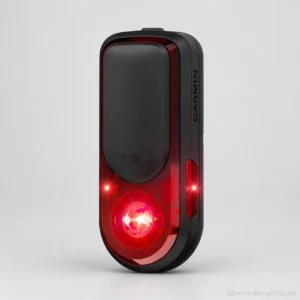
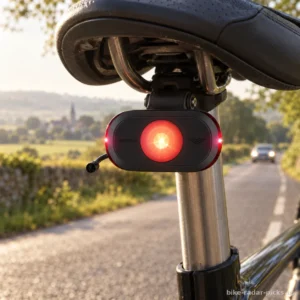
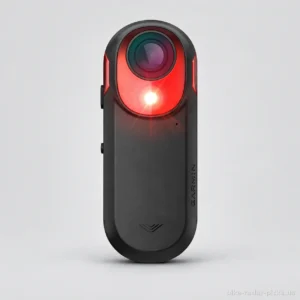
Garmin Varia RCT715
Top-ranked for equipment.
Read the review Our rankingsThe best bike radars23 bike radars
By compatible with a bike computer
By detection range
By battery life
Features and options
Our guides to choosing
Prices in USD are indicative: they are converted from the reference catalogue prices in euros at a fixed rate (EUR 1 = $1.08, 9 Sep 2026) and are not prices from a local retailer. The price at your retailer prevails. (14 Sep 2026)
The selected models vary in price. Compare each bike radar based on your alert or recording needs. Use the filters to narrow down your choice.
Prices collected from retailers are for guidance only: they may have changed since, the current price is the one shown by the retailer. No price is shown for models sold only on Amazon. Amounts converted from reference prices in euros using a dated exchange rate.
Top-ranked for equipment.
Read the review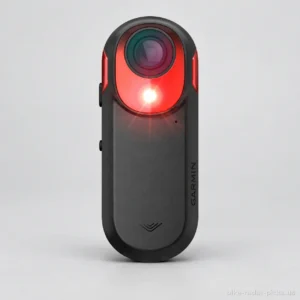
Key strength: equipment, rated 8.9/10.
Read the review
Top-ranked for light output.
Read the review| Rankings | Rating | Price | Detection range | Battery life | Weight | Light output | Detection angle | Charging time | Battery capacity |
|---|---|---|---|---|---|---|---|---|---|
| 1. Garmin Varia RCT715 | 7.8/10 | n/a | 140 m | 6 h | n/a | 65 lm | 40 ° | 3 h | n/a |
| 2. Garmin Varia RCT716 | 7.4/10 | n/a | 140 m | 5 h | 147 g | 5 lm | 40 ° | 3 h | n/a |
| 3. Garmin Varia RearVue 820 | 8.6/10 | n/a | n/a | 30 h | 90 g | 100 lm | 60 ° | 2.5 h | n/a |
| 4. Garmin Varia RearVue 820 StVZO | 8.3/10 | $302 | n/a | 30 h | n/a | n/a | 60 ° | 2.5 h | n/a |
| 5. Garmin Varia eRTL616 | 8/10 | $216 | 140 m | n/a | 50 g | 5 lm | 40 ° | n/a | n/a |
Rankings are based on our review ratings, calculated by comparing manufacturer specifications across the full catalogue.Our methodology.
On the road, the benefit is having additional information about approaching vehicles. On your daily journeys, this can make it easier to monitor your surroundings. On group rides, your choice of lighting also matters: the RearVue 820 offers a peloton mode designed to reduce discomfort for cyclists behind you.
This type of equipment is particularly suitable if you want to:
If you are looking for a Garmin-compatible bike radar, check the exact receiver model. The RearVue 820 is listed as providing alerts on a compatible Edge bike computer, a Garmin smartwatch or the Varia smartphone app. This does not mean that every device provides access to all functions.
An alert supports your awareness: it does not guarantee that a vehicle will overtake safely or remove the need to look behind you before changing direction.
These devices serve different purposes. The radar signals an approaching vehicle, the light makes you visible and the camera records footage. Their specifications are therefore not interchangeable.
The RearVue 820 specifications list vehicle detection at distances of up to 175 m and light visibility at distances of up to 2 km. This latter distance does not represent the radar range.
A bike radar with braking detection adds a lighting function linked to slowing down. The RearVue 820 is listed as providing a brake light when you slow down or stop. This function is separate from the alerts the cyclist receives.
A camera becomes relevant if you want to retain footage in the event of an incident. The RCT716 is listed as recording in 1080p at 30 frames per second, automatically saving footage before, during and after a detected event.
This feature means considering battery life, storage and how to view the files. A 16 Go card is listed, with no recording duration specified. The stated battery life is 5 h, but the conditions are not detailed: have them confirmed for your longer rides.
The selection on this page will help you match these needs to each model’s documented specifications, including their strengths and the points to check before buying.
Based on an analysis of its specifications, the Garmin Varia RearVue 820 is the best-documented choice for combining rear alerts with customisable lighting. The RCT716 is worth considering if you want to record your rides. The prices of the models in this selection do not establish their respective reliability.
Your priority should determine your choice: receiving alerts, adjusting the lighting or recording footage. Here is a comparison of the available data.
| Model | Price | Weight | Mounting type | Physical dimensions |
|---|---|---|---|---|
| Garmin Varia RearVue 820 StVZO | Check price with the retailer | N/A | N/A | N/A |
| Garmin Varia RearVue 820 | Check price with the retailer | 3,2 Ounces | Seatpost mount | 98,9 x 25,9 x 43,2 mm (3,9” x 1” x 1,7\") |
| Garmin Varia RCT715 | Check price with the retailer | 71,0 g (2,5 oz) | N/A | 98,6 x 19,7 x 39,6 mm (3,9″ x 0,8″ x 1,6″) |
| Garmin Varia RCT716 | Check price with the retailer | N/A | Windshield mount | N/A |
Check your receiver’s exact model before ordering. Having ANT+ or Bluetooth does not guarantee that all information will be displayed. A Garmin-compatible cycling radar must be paired with a device that supports the functions you want.
The RearVue 820 lists ANT+ and Bluetooth connectivity for the radar and lights. Its description specifies alerts on a compatible Edge bike computer, a compatible Garmin watch or a smartphone with the Varia app. However, the requirements for accessing advanced vehicle alerts are not fully documented.
For the RCT716, use of the Varia app on a compatible smartphone is documented. Check alert reception, camera control and video viewing separately.
Radar range and light visibility measure different functions. The RearVue 820 claims vehicle detection at up to 175 m and a light visible from up to 2 km away. The second distance therefore does not indicate how early alerts can be given.
The RCT716 claims detection at up to 140 m. This difference alone is not enough to determine which is more reliable in traffic. Likewise, the listed viewing angles should not be treated as detection angles when their purpose remains unclear.
Do you ride in a group? A cycling radar with peloton mode may help guide your choice. This mode is listed for the RearVue 820 and RCT715. Also check which light modes are permitted in the country where you ride.
Compare the length of your rides with the battery life in the mode you actually use. Allow a margin for detours and missed charges. A figure achieved with a different light setting or without recording may not meet your needs.
No battery life is specified for the RearVue 820 models. Ask for this information before choosing them for long rides. The RCT716 claims 5 h without specifying the operating conditions.
For the RCT715, the specifications state 6 to 16 h depending on the light setting. Have these figures confirmed for the exact model on sale and ask whether they include video recording. They are not enough to recommend this model for a full day with the camera running.
Do not assume the standard RearVue 820’s specifications apply to its StVZO version. The latter’s description specifies neither modes nor battery life. StVZO approval is explicitly stated for the RCT716.
Check your seatpost’s shape, the included mount and the clearance behind a saddle bag. The RearVue 820 lists seatpost mounting. The RCT716 specifications mention this position, but also a windscreen mount that is inconsistent with the intended use. Have the exact package contents confirmed.
If you are looking for an IPX7 cycling radar, this rating is listed for the standard RearVue 820, RCT715 and RCT716. It is not specified for the RearVue 820 StVZO in the available information.
The RCT716 specifies recording in 1080p at 30 frames per second, an included 16 Go card and automatic saving of footage surrounding an incident. No usable recording capacity is stated in terms of duration. Check how to retrieve files and manage the card.
For the RCT715, request complete camera documentation before choosing this model for recording.
Choose the RearVue 820 for its documented alert and lighting features, or the RCT716 for recording. In either case, check compatibility, battery life and mounting before buying. Missing information on the other models warrants checking with the seller.
Choose a device whose alerts are properly supported by your bike computer or phone. The stated range alone does not determine real-world effectiveness. The RearVue 820 lists a detection range of up to 175 m, compared with 140 m for the RCT716, but this does not demonstrate superiority in every situation. Above all, check the receiver’s exact compatibility and the information it displays. An alert never guarantees that an overtaking manoeuvre will be safe.
There is not enough information to compare the Bryton Gardia R300 precisely with the selected Garmin Varia models. Other comparison sites mention the R300L in particular, a model that should not automatically be confused with the one you are looking for. Garmin Varia also covers several models with different features. To choose a Garmin-compatible bike radar, check the radar and bike computer model numbers, then compare the available alerts, battery life and features that are actually documented.
Choose a bike computer whose documentation explicitly confirms compatibility with your radar and the alerts you want. For the RearVue 820, the product specifications mention compatible Garmin Edge bike computers without giving an exhaustive list. ANT+ or Bluetooth connectivity alone does not guarantee access to every feature. In particular, check whether the bike computer displays advanced vehicle information, rather than just approaching vehicles, before deciding to replace it.
Yes, the RearVue 820 and RCT716 specifications support using the Varia app on a compatible phone. The RearVue 820 can send approaching vehicle alerts to the app. For the RCT716, the specifications also mention viewing videos and controlling the camera. Check your phone’s compatibility and the requirements for receiving alerts before buying. Also make sure your phone has enough battery life for your ride.
The StVZO version is not documented in enough detail to establish all its differences from the standard RearVue 820. Of the 2 models, the standard version specifically lists steady, peloton and flashing modes, but these features should not be assumed to apply to the StVZO variant. If you are looking for a cycling radar with peloton mode, this function is documented for the standard model. Confirm the modes supported by your chosen version and their compliance with local regulations.
A built-in camera is useful if you want to keep footage of an incident. The RCT716 specifies recording in 1080p at 30 frames per second, an included 16 GB card and automatic saving of footage around an incident. Its specifications state 5 h of battery life, without specifying the conditions. Check the battery life with recording enabled and how to access the footage. The stated capacity does not indicate how much recording time can be stored.
No, light visibility and radar range measure different functions. For the RearVue 820, the specifications state up to 175 m of vehicle detection range and up to 2 km of light visibility. The first value refers to vehicles detected behind you; the second refers to the distance from which the light can be seen. Do not compare these figures as though they measure the same performance or consider them guaranteed in all conditions.