Best bike radar Lezyne 2026, analysis and reviews
Explore our selection of Lezyne bike radar models, with the key criteria to compare the 2 models in the range and a buying guide to make the right choice.
Prices collected from retailers are for guidance only: they may have changed since, the current price is the one shown by the retailer. No price is shown for models sold only on Amazon. Amounts converted from reference prices in euros using a dated exchange rate.
How we picked these models
- 2 models selected because they have the feature “Lezyne” according to data published by manufacturers and retailers.
- See how we rate →
- No brand pays to be included in this selection or to rank higher.
Why does the Lezyne bike radar stand out in this market?
What Lezyne brings to the cycling radar market
Lezyne is not a brand that improvises. Long recognized for its lights and technical pumps, it enters the cycling radar segment with a coherent proposition. Rear vehicle detection up to 150 meters (according to manufacturer data) sits at the high end of the market. The dual connectivity ANT+ and Bluetooth allows connection to compatible GPS computers or to the mobile app Lezyne Radar Ally, available on iOS and Android, to receive visual and audio alerts directly on the screen or on a smartphone. Charging via USB-C simplifies day-to-day management. Finally, 7 lighting modes are available, including a disruptive daytime flash of 300 lumens that activates automatically when a vehicle is detected.
The strengths that emerge from the analysis of the offering
What sets the Lezyne offering apart is first the compact housing: the form factor remains unobtrusive on the bike compared to several competing models. The automatic flash trigger upon vehicle detection is a concrete active safety argument. But perhaps the most practical advantage is this: Lezyne radars work as a fully standalone rear light, without a connected GPS computer. For a cyclist without a computer, or whose computer is not compatible, this represents genuine freedom of use. Native compatibility with Lezyne computers, and access to alerts via ANT+ for a cycling radar compatible with a Garmin or Wahoo, further broadens the potential user profile.
What to know before buying
The analysis of the offering reveals 3 points to watch. The Lezyne radar range is limited to 2 rear models only: no dedicated front radar option currently exists from this brand. Field feedback on the real-world battery life depending on the modes used remains limited, as the product is recent. Users who have shared their experience also flag the rubber mounting straps as a point to monitor over time. For cyclists looking for a bike radar to mount on a seatpost with a specific shape, compatibility should be checked before purchase.
The verdict on Lezyne as a radar manufacturer
In a market long dominated by Garmin Varia, Lezyne has established itself as a serious alternative backed by a brand with a strong track record in cycling lighting. Both the Radar Drive Rear and the Radar StVZO Rear are priced below several competitors offering comparable features. That said, Lezyne's recent entry into this segment calls for caution: data on long-term durability and radar reliability across varied conditions remains limited. Value for money should be assessed against your riding profile, habits, and GPS ecosystem. The selection on this page helps you identify the Lezyne model best suited to your use.
Our complete assessment of the Lezyne bike radar range
Lezyne has positioned itself in the bike radar segment with a coherent technical approach. Based on analysis of available specifications, their lineup centers on 2 rear units sharing the same technological foundation: a proprietary radar with vehicle detection at 150 meters, dual ANT+ and Bluetooth connectivity, and 7 lighting modes including a 300-lumen daytime flash according to manufacturer data. What immediately stands out is the compact housing and USB-C charging, a universal standard that contrasts with the proprietary connectors still found on some competitors. The lineup is deliberately kept to 2 models. The only structural differentiator is StVZO certification. This reflects a clear vision, but it also means there is no version with an integrated camera or a dedicated front radar in the lineup.
| Criterion | What to look for | Common mistake |
|---|---|---|
| Detection range | At least 140 to 150 meters to give you enough time to react on road or gravel | Settling for a model advertised at 100 meters or less: reaction time becomes insufficient at higher speeds |
| Connectivity | ANT+ and Bluetooth simultaneously to work with the widest range of GPS computers | Choosing a Bluetooth-only radar light, incompatible with ANT+ computers |
| Lighting modes | A powerful daytime flash mode and an auto mode triggered upon vehicle detection | Overlooking daytime visibility, which is often more critical than nighttime in urban areas |
| Road certification | Check StVZO compliance if you commute by bike or travel through Germany, Austria, or the Netherlands | Ignoring certification and ending up non-compliant on a trip through Central Europe |
| Mount | A solid and versatile system, compatible with a standard round seatpost | Underestimating the mount: a light that rotates or vibrates while riding throws off radar detection |
| Real-world battery life | Cross-reference manufacturer data with real-world feedback from several months of use | Relying solely on manufacturer figures without checking real-world performance reports |
Strengths of the Lezyne lineup
- 150-meter radar range according to manufacturer data, in line with the best market standards in 2026.
- Dual ANT+ and Bluetooth connectivity: compatible with GPS computers from all brands via ANT+, and with the Lezyne Radar Ally app on iOS and Android for cyclists without a computer.
- 7 lighting modes including a 300-lumen daytime flash. A high output for this form factor, ensuring effective visibility in direct sunlight.
- Standalone operation possible: the light works without a GPS computer, using its own flashing mode triggered upon vehicle detection.
- USB-C charging: a universal cable, more convenient than a proprietary connector for everyday use.
- StVZO version available for compliance with Europe's strictest regulations, at a minimal price premium over the standard model.
Drawbacks to know before buying
- Rear range only: no dedicated front radar, no version with an integrated camera. Cyclists looking for a complete front and rear monitoring solution will need to supplement with another brand.
- Limited real-world track record: data on battery degradation and multi-season reliability remains scarce. Garmin Varia models have a well-documented history that Lezyne has not yet built up.
- Rubber mounting straps flagged as a concern in several user reports. For a bike radar designed to mount on a seatpost, their vibration resistance and long-term durability deserve confirmation in real-world use.
- Limited synergies outside the Lezyne ecosystem: cross-alerts between the front light and rear radar are optimized for a 100% Lezyne setup. A cyclist using a different computer benefits from the radar, but not from all the system's features.
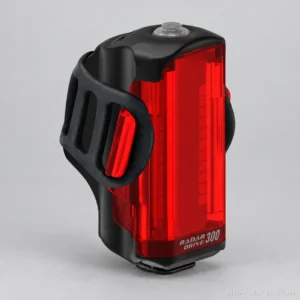
Radar Drive Rear Analysis
The Radar Drive Rear is the entry point into Lezyne's radar lineup. The pitch is straightforward: all the brand's radar technology in a compact, USB-C rechargeable unit. For road and gravel cyclists riding in France with no cross-border regulatory constraints, it is the natural choice. Via ANT+, it is a bike radar compatible with a Garmin computer as well as most other GPS computers. The Lezyne Radar Ally app is also an option for those who prefer smartphone alerts. User feedback consistently points to a well-executed balance of compactness and connectivity, with one caveat: real-world battery life in active radar mode has been poorly documented over time.
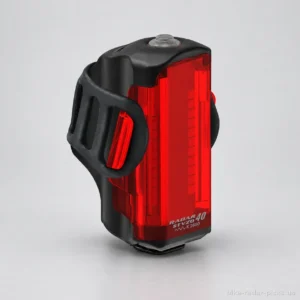
Radar StVZO Rear Analysis
The Radar StVZO Rear packs exactly the same radar and lighting modes as the Drive Rear. The difference lies in its StVZO certification, a German standard regulating light output and beam angle to prevent glare for other road users. This certification is mandatory for legal road use in Germany, Austria, and several Central European countries. In France it is not legally required, but it serves as a reliability indicator for commuters in dense urban settings or cyclists who regularly cross borders. The modest premium over the Drive Rear makes for an easy trade-off.
Our verdict
Who it is for. The Radar Drive Rear is aimed at road and gravel cyclists looking for a serious alternative to the Garmin Varia, with a compact unit, USB-C charging, and broad compatibility via ANT+ and Bluetooth. The Radar StVZO Rear suits commuters, touring cyclists crossing Europe, and anyone who prefers to ride by the rules without having to check regulations country by country.
Who should avoid it. If you need an integrated camera or a dedicated front radar, the Lezyne range does not yet cover those needs. If real-world data on battery lifespan and mounting strap durability is a deciding factor for you, it may be worth waiting a few more months of additional user feedback before making a decision.
The most common questions about the Lezyne bike radar
What is the detection range of the Lezyne radar?
The Lezyne radar detects vehicles approaching from the rear up to 150 meters, according to manufacturer data. This range is shared across the 2 models in the lineup (Radar Drive Rear and Radar StVZO Rear). As a vehicle approaches, the light automatically adjusts its flashing pattern and an alert is sent to the GPS computer or the Lezyne Radar Ally app.
What is the difference between the Lezyne Radar Drive Rear and the Lezyne Radar StVZO Rear?
The 2 models share the same radar technology (150 m range, dual ANT+/Bluetooth connectivity, 7 lighting modes, USB-C charging). The difference lies in certification: the Radar StVZO Rear is approved to the StVZO standard, a German regulation governing beam intensity and angle for legal use on public roads in several European countries. The Radar Drive Rear is aimed at leisure and sport cyclists, while the Radar StVZO Rear suits daily commuters and cyclists travelling through countries with strict road regulations.
Is the Lezyne radar compatible with Garmin and Wahoo computers?
Yes. Lezyne radars feature dual ANT+ and Bluetooth connectivity. A bike radar compatible with a Garmin computer or a bike radar compatible with a Wahoo computer works via the ANT+ protocol. For cyclists without a computer, the connection is established via Bluetooth with the Lezyne Radar Ally app (iOS and Android). Compatibility with other GPS brands should be verified based on your specific model.
Is a GPS computer required to use the Lezyne radar?
No. Lezyne radars operate in fully standalone mode, with no computer or smartphone needed. They remain active with their 7 lighting modes, including one mode that triggers automatically when a vehicle is detected. To receive visual and audible approach alerts on a screen, a GPS computer compatible with ANT+ or the Lezyne Radar Ally app on a smartphone is required.
Can the Lezyne radar work as a simple rear light without being connected to a computer?
Yes, and this is a practical advantage for cyclists who do not have a GPS computer. Without an established connection, the light remains fully operational with its 7 lighting modes. Among these modes, a 300-lumen daytime flash provides maximum daytime visibility, according to manufacturer data. The flashing can also trigger automatically when a vehicle approaches, even without a remote alert on a screen.
How long does the Lezyne radar battery last depending on the mode used?
Available product data does not specify exact battery life per mode. Feedback analysed on cycling forums highlights that battery life varies considerably depending on the mode selected, with the 300-lumen daytime flash logically being more power-hungry than flashing modes. Users also note that real-world feedback on actual battery longevity remains limited, as this product has only recently come to market.
Is the Lezyne Radar StVZO approved for riding on public roads in France?
The StVZO standard is a German certification, not a legal requirement in France. Riding with the standard Radar Drive Rear remains legal in France. The Radar StVZO Rear is particularly relevant for bike commuters who want regulated beam lighting, or for cyclists who ride in Germany and other European countries where this standard is required for use on public roads.
How do you mount the Lezyne radar on a road or gravel bike?
Mounting is done using rubber straps. If you are looking for a bike radar to attach to a seatpost, compatibility is ensured in the majority of standard configurations. Feedback analysed on forums flags these straps as a point to watch: their long-term durability and their fit on profiled or aerodynamic seatposts should be verified based on the exact geometry of your bike.